

Stainless steel furniture: function, health, and longevity in a single solution
The material, in brief: 304 vs. 316L, passive film, and surfaces
Stainless steel is an iron-chromium alloy where at least 10.5% chromium forms a self-healing passive oxide film. This film makes the material resistant to corrosion and is why furniture can maintain its shape and finish for decades without varnish. According to the International Stainless Steel Forum, worldstainless, austenitic grades like 304 and 316/316L are the most commonly used because they combine formability, strength, and stable corrosion resistance. 316/316L also contains molybdenum, which improves resistance to chlorides and salt—relevant for coastal locations or south-facing window zones with condensation.
For furniture, austenitic stainless steel provides both structural strength and a precise, tactile surface. Finishes range from mirror-polished to more subdued tactility:
- Introduction of surfaces: brushed, satin, and mirror. On large surfaces, we typically choose brushed or satin to reduce glare and highlight sharp geometry without visual noise. Mirror is selectively used on smaller elements where reflection is desired as an active element.
For home use, this means the same material can be both structural and decorative. Folds, precision bending, hidden joints, and hand-polishing create a calm aesthetic that patinates minimally and can be renewed by service polishing.
Danish craftsmanship in Aarhus: welds, edges, and reparability
Acier Studio produces small batches in Aarhus. This allows time for details that do not exist in mass production: TIG welds that are subsequently blended and hand-polished in the grain direction, precise edge radii that feel right in the hand and protect the passive film, and hidden fastenings that allow surfaces to appear as continuous planes. Tight tolerances in bending and joining ensure that shadow gaps appear crisp.
This approach follows a Danish tradition of durable metal craftsmanship, where quality lies in what is almost unseen: that corners meet seamlessly, that transitions do not disrupt the flow of light, and that the furniture can be disassembled, repaired, and repolished after many years of use. This is diametrically opposed to lightweight tubular construction with spot welds, which cannot be adjusted or service-polished to the same standard.
In the studio: the stainless steel collection
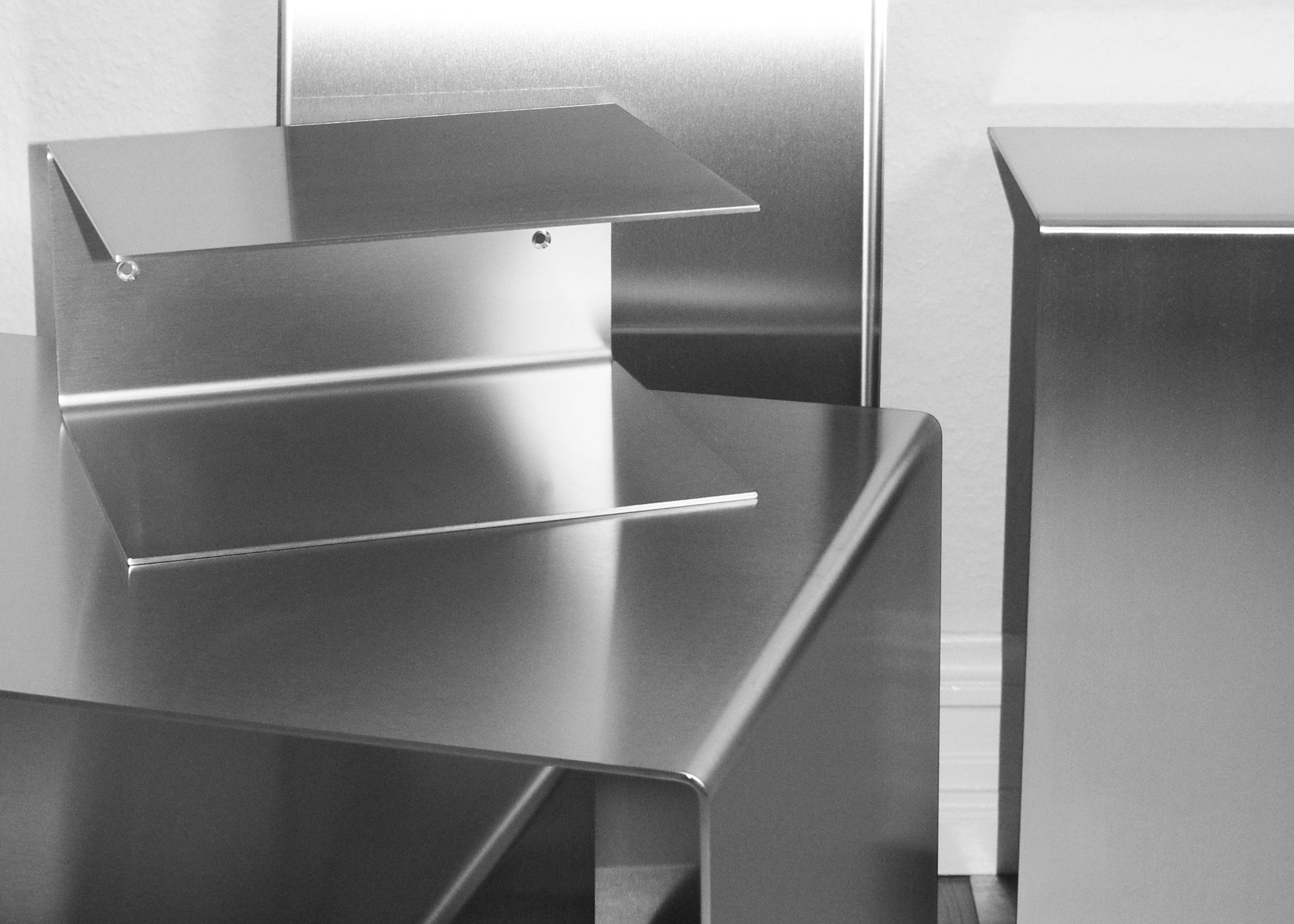
In the studio, the Lund bedside table, Skagen shelf, a coffee table from the Copenhagen/Uppsala family, and the Oslo pedestal are shown. Dramatic side lighting reveals what defines the series: crisp, folded edges, precise geometry, and brushed flat surfaces where the grain direction consistently aligns along the same axis on related parts. Sharp shadows at edges show that welding and bending are designed together—no visible fastenings interrupt the whole.
A concrete example is the Uppsala coffee table in steel. The tabletop appears as a thin, calm plane, where the brushing is directional to minimize glare at seating height. Support is achieved with folds and downward bends rather than visible frames, providing rigidity without visual heaviness. Joints are TIG-welded and subsequently blended so that the flow of light is not interrupted at the corners. Small adjustable glides protect the floor and allow for fine leveling on older wooden floors. The result is a table that withstands daily use and appears disciplined in plane and edge. See the object in context on the product page for the Uppsala coffee table.
Hygiene, allergies, and honest maintenance
Hygienically, stainless steel is non-porous and easy to clean. A correctly passivated 316L surface releases very few metal ions and is widely used where skin contact and hygiene are crucial. However, the International Molybdenum Association (IMOA) points out that individuals with severe nickel allergies may still react to prolonged direct contact; in such cases, low-nickel-releasing grades, special grinding, or surface treatments can be specified if the furniture is used as a prolonged contact surface.
Maintenance involves preserving the passive film and grain direction:
- Clean regularly with lukewarm water and pH-neutral dish soap; dry along the grain with a microfiber cloth to prevent limescale stains.
- Avoid chlorine-containing agents, bleach, and abrasive creams; never use steel wool or workshop scouring pads.
- In coastal locations, "tea staining" (slight brownish discoloration) may occur on exposed facets; remove it early with a mild, acid-free steel cleaner or a citric acid-based passivation gel according to the manufacturer's instructions.
- Fingerprints on brushed surfaces are most easily removed with isopropyl alcohol on a soft cloth; work along the grain.
- Use coasters under highly staining liquids and acidic foods; stainless steel rarely gets damaged, but wiping up spills reduces the risk of marks and preserves the finish.
If a surface has become uneven in sheen after many years of use, it can be re-polished to the same grit. This requires maintaining the grain direction throughout the entire element; professional handling is recommended here to preserve edges and radii.
Interior design, surfaces, and long-term value
Stainless steel lends a precise, cool element to a room, which can be balanced with warm materials. Combine brushed surfaces with oak, walnut, saddle leather, or limestone to create depth and temperature balance. For large planes, we recommend brushed or satin for calm light; mirror is reserved for smaller sections where reflection can intensify volume. If furniture is placed close to large windows or in coastal zones, choose 316/316L and allow easy access for periodic cleaning.
From a sustainability perspective, stainless steel is close to circular. The material can be recycled again and again without significant loss of properties, and the industry reports high recovery rates at end-of-life, which underscores the long-term durability in the overall cycle (worldstainless). When design, material, and craftsmanship are prioritized, maintenance primarily becomes a matter of easy cleaning and occasional service polishing—not replacement.
Over time, it is therefore not merely an aesthetic choice. A piece of stainless steel furniture from a small, Aarhus-based production, with clean joints, correct grinding, and specified steel quality for the environment, maintains its geometry, preserves its hygiene, and can be repaired rather than discarded. This economy, this tranquility, and this material integrity are what make the investment durable across generations.

