

Danish Steel Furniture Design: Acier Studio's Approach to Timeless Form, Local Craftsmanship, and Durable Materials
Stainless steel solves three specific problems in the home: it resists corrosion, it bears heavy loads with a low profile, and it maintains its geometry and finish for years without extensive maintenance. For a Danish environment with fluctuating humidity, daily use, and a focus on clean lines, the material is a pragmatic choice, not a mere trend.
Material Knowledge: Alloy, Finish, and Performance
At the core of stainless steel is the passive chromium oxide film, which spontaneously forms on the surface and ensures long-lasting resistance to stains and corrosion. According to Outokumpu, a leading producer and knowledge source for stainless steel, the film's stability and correct post-treatment—including pickling and passivation—are crucial for longevity and consistency in finish (see Outokumpu's overview of corrosion resistance). The choice between austenitic, ferritic, or duplex steel also offers different combinations of formability, weldability, and strength, enabling slender profiles without compromising stiffness.
The finish dictates how the steel is perceived in a room. A directionally brushed, satin-like surface dampens reflections and appears warm and calm, while a high-gloss polished surface elevates the light level but requires more discipline in use and cleaning. In practice, we specify austenitic 304 for indoor furniture, and 316 is used where chloride exposure is higher, e.g., in coastal projects. Important nuances such as grinding direction, grit size, and subsequent passivation are established early in the process, as tool setup and workflow follow the chosen system.
Beyond function, steel offers a verifiable material cycle. Stainless steel has a high recycling rate, and when sourced from low-CO₂ producers, it can be a material with low embodied carbon. In a Danish craftsmanship setup, where waste is tightly controlled and components are precisely dimensioned, this becomes a tangible quality.
The Aarhus Workshop: Process, Tolerances, and Repair
Small series and bespoke solutions define our work. Components are laser-cut or sheared, bent in fixtures, and assembled with TIG welding, keeping heat input and distortion low. Joints are mechanically worked, after which weld zones are cleaned, pickled, and passivated to restore the passive film. Final grinding takes place in several stages with controlled grit direction, ensuring optically smooth transitions that are easy to maintain.
This workshop logic—material selection, manual fitting, and a local supplier network—results in tight tolerances and genuine verifiability. A fully welded steel furniture piece can be disassembled, straightened, re-ground, or updated with a new surface, unlike laminated or composite-based alternatives. The result is not just aesthetics; it is documented reparability and traceable origin.
Product Insight: Uppsala Coffee Table in Solid Steel
At the lighter end of our range is our Uppsala coffee table. The table features a slender profile and an open base, maintaining visual calm in the living room. Frames and feet are TIG-welded in fixtures, after which the corners are ground to smooth transitions without visible breaks in the grinding direction. The surface is directionally brushed to minimize glare and simplify daily cleaning. The proportions of the underframe provide a stable base, while thin-walled profiles keep the weight down and withstand point loads from books, stones, and trays without yielding.
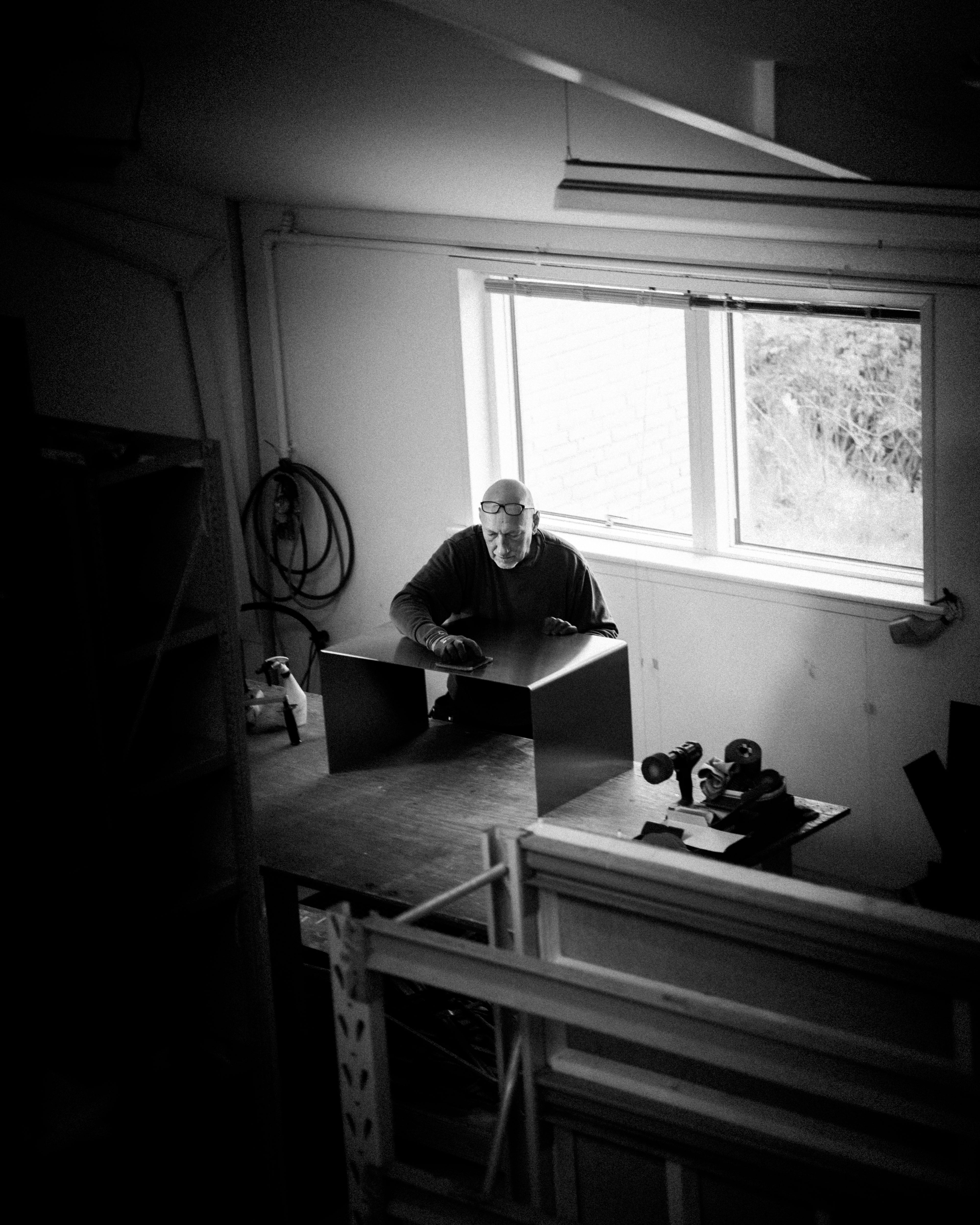
The image from the Aarhus workshop shows the final hand-grinding on an Uppsala frame. Here, the surface uniformity is checked with low-angle lighting, and minor irregularities are corrected before passivation ensures final corrosion resistance. The close cadence between grinding, inspection, and cleaning creates the calm, technical character that distinguishes steel furniture designed for longevity.
Interior Design: Material Balance in a Scandinavian Context
In Scandinavian spaces, steel reads as a cool, architectural accent. Balance is achieved when it is paired with warm species like oak or teak, tactile textiles, and matte stone surfaces. The finish is central: a brushed or matte surface offers more calm than a polished one. To avoid an industrial look, wood and textile should dominate in scale, while steel carries the structure or marks the contour. Trend analyses from Nordic Nest highlight mixed materials and muted metallic accents as continually relevant in 2025, because they support light, proportion, and function over mere decoration.
Maintenance: Specific Actions, Not General Advice
Stainless steel is low-maintenance, but its quality in use depends on correct habits:
- Clean regularly with lukewarm water and a pH-neutral dish soap. Wipe dry with microfiber along the grinding direction.
- Remove grease and fingerprints with isopropyl alcohol on a cloth. Always test on an inconspicuous area first.
- Avoid chlorine-based cleaners and abrasive creams. They can attack the passive film or scratch the surface.
- For light wear scratches on a brushed finish, a fine, non-abrasive nonwoven pad can be gently used in the grinding direction to even out the appearance. Work lightly and evenly.
- Acidic food spills should be wiped up immediately. Prolonged contact can cause discoloration that requires subsequent polishing.
Indoors, stainless steel typically requires no additional surface treatment. If furniture is placed near coastal environments or swimming pools, the cleaning frequency should be increased to keep chlorides away from the surface. Properly performed passivation after welding is a prerequisite for these simple routines to work over time, as Outokumpu also emphasizes.
Long-Term Value
When a stainless steel furniture piece is designed with careful consideration for grinding direction, profile, and joint details, it becomes calm to live with and rational to maintain. Danish, workshop-based production anchors this quality in practice: precision in small series, repairability, and transparent material usage. In a home furnishing portfolio where pieces move rooms or are passed down through generations, it's not the high-gloss moment that counts, but predictable aging, simple service, and documented resilience. This is where stainless steel—and a local, responsible manufacturing method—delivers value year after year.

