

Steel magazine shelf: a display that organizes and stages
A steel magazine shelf is first and foremost about clarity and readability. In the living room or a studio, spines and covers must be quickly legible, and the shelf must bear the weight without dominating the space. When the interior surface is polished, it reflects light back onto the edges of the papers; the results are clear contours, calm shadows, and a precise display of each individual magazine. In practice, interior designers combine the cool luster of steel with wood, stone, and textiles to maintain balance in the room. Livingetc describes how mixed metals and natural materials create warmth and depth in contemporary interiors.
Material and surface: why stainless steel provides calm and strength
Stainless steel is suitable for slender, load-bearing shelves because it combines high strength with durability. Its corrosion resistance stems from a chromium-rich passive oxide layer that regenerates itself from minor scratches. Austenitic grades with nickel—typically 304 and 316—add toughness, good weldability, and non-magnetic properties, allowing for thinner gauges without compromising load capacity. Nickel Institute elaborates on these relationships and recommends specifying steel grade and surface finish in the same breath; see their technical guide, Specifying Stainless Steel Surface Treatments.
The surface finish controls reflection. An interior in mirror-polished or electropolished quality provides high, specular reflection and a distinct play of light around the edges of the magazines. An exterior in brushed/No.4 texture reduces glare, hides small scratches, and minimizes visible fingerprints upon touch. The choice is therefore functional: polished where you want to highlight the content; brushed where you touch.
Bodø magazine holder: wall-mounted display in modular rhythm
Bodø is Acier Studio's wall-mounted stainless steel magazine holder, handcrafted in Aarhus in small batches. It functions as a shallow, open cradle for covers facing out into the room, allowing print materials to be read as a calm frieze on the wall. The inner bowl is polished to enhance depth and light, while the outer geometry is clean and calm, maintaining a graphic wall surface.
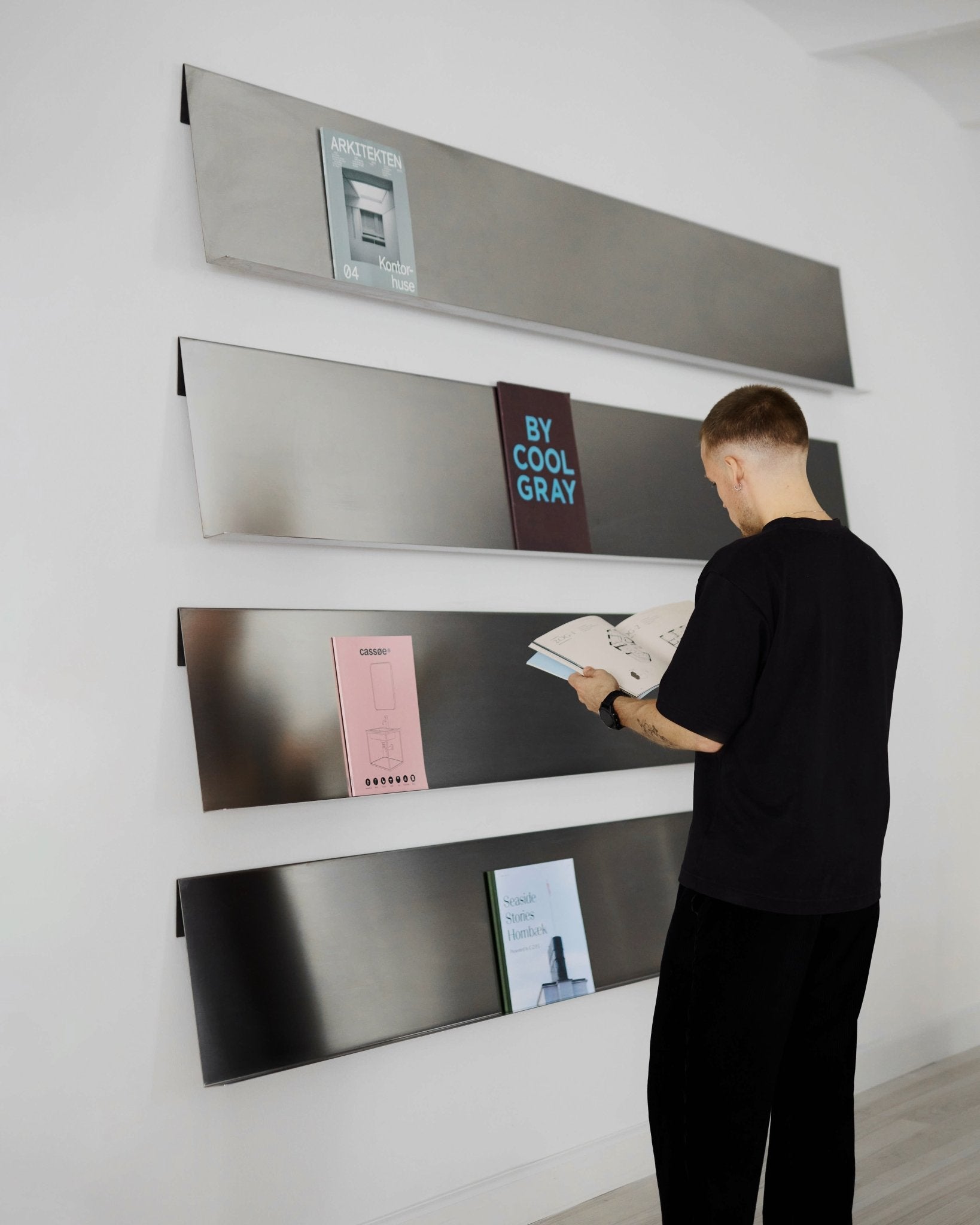
The image above shows four Bodø units in a horizontal row, each with one publication front-facing—Arkitekten, By Cool Gray, a Cassøe catalog, and Seaside Stones Hornbæk. The polished interior catches and reflects light, making each cover appear sharp, and the wall gains a consistent, high-contrast rhythm. This is precisely the point: a shelf that doesn't hide magazines but presents them.
To accommodate common formats, we work within well-documented measurements. Standard consumer magazines vary around A4/US Letter; Sizecrafter summarizes that an internal width of at least 230 mm is appropriate. In practice, the following dimensions provide a good balance between support and visibility:
- Internal width: ≥230 mm; depth: approximately 200–300 mm; visible front height: approximately 300–400 mm
These dimensions allow for stacked or single display without pinching spines or deforming corners. The slightly upward angle towards the back ensures the cover stays upright, even when browsing. If several units are placed in series, the inter-unit spacing can be adjusted to control the wall's rhythm—close for a compact band, airy for a gallery-like reading of each title.
Maintenance and daily use
A polished interior thrives on light, but it also reveals fingerprints. This is the condition for a reflective surface; the advantage is that it can be restored to full luster with proper care.
- Daily wiping: Use a soft microfiber cloth, slightly dampened with lukewarm water and a few drops of pH-neutral soap. Wipe in the direction of the fibers to avoid streaks.
- Grease and marks: A small amount of isopropyl alcohol on the cloth removes grease without attacking the surface. Avoid abrasive cleaners and steel wool, which scratch.
- Limescale spots: For hard water, a weak citric acid solution (3–5%) can dissolve limescale; rinse thoroughly and dry completely to maintain the shine.
- Chlorides: Avoid cleaning agents with chlorine or bleach, which can attack the passive film over time.
- Surface specification: An electropolished interior is more resistant to dirt accumulation and easier to keep even; this is also highlighted by the Nickel Institute in their technical guide on specifying surface treatments.
- Handling: Lift magazines by the edges to minimize marks on the shelf's interior. When mounting, gloves can save an initial polish.
If the shelf gets scratched, a professional can restore the finish; brushed surfaces can be re-lined in the direction of the grinding pattern, while mirror-polished surfaces require a fine build-up of grit and polishing paste.
Danish small-scale production: precision, repair, and proportion
Bodø is manufactured in Aarhus in small batches with a focus on proportions and craftsmanship. In Danish workshop production, quality lies in the hand-tuned welds, the continuity of the grinding pattern, and the way edges are rounded to feel smooth in the hand. This studio-to-small-scale model—supported by professional and political environments, as Formkraft documents—allows for adjustments in tolerances and proportions that mass-produced punched and robot-welded systems typically do not offer. It also makes repair and refinishing realistic over the product's lifespan, as one can return to the same workshop logic. For further insight into materials and processes, we describe our approach under Production and materials at Acier Studio:
In the interior, Bodø functions as a fixed but discreet anchor point. The cool luster of the steel meets the pores of wood, the crystals of stone, and the matte surfaces of textiles in a way that makes the room easy to read. Livingetc points out that precisely this blend creates warmth around cool metals; this also applies to a wall with magazines, where the colors of the paper are allowed to carry the expression.
Perspective: long lifespan and stable value
Stainless steel ages slowly. The chromium-rich passive film renews itself, and surfaces can be refreshed. A magazine holder like Bodø therefore does not change character from year to year; it retains its geometry, its support, and its ability to make content readable. When combining well-crafted, Danish small-scale manufacturing with well-chosen surfaces—polished where light needs to work; brushed where the hand meets the object—you get a piece of furniture that can be integrated into new arrangements and spaces over time without losing function or visual tranquility. It is in this robustness, not in short-lived effects, that long-term value lies.

