

Stainless Steel: Care, Cleaning, and Longevity
Stainless steel endures because a thin, passive film of chromium oxide covers the surface, protecting it from corrosion. Care involves preserving and restoring this film, keeping the surface clean of chlorides, iron particles, and deposits, and respecting the original grain direction. Below, you'll find a practical, comprehensive guide to daily maintenance, deep cleaning, what to avoid, and how to restore the grain on a brushed surface.
Daily Care: Clean, Dry, and with the Grain
For daily cleaning, warm water and a mild, pH-neutral dish soap are sufficient. Use a soft microfiber cloth, work in the same direction as the steel's grain, and rinse with clean water. Dry the surface completely to avoid limescale and fingerprints. For greasy marks, isopropyl alcohol (around 70%) on a microfiber cloth can be used for spot treatment; wipe with water afterward and dry.
In areas with hard water, a light solution of household vinegar helps remove limescale. Apply briefly, rinse thoroughly, and dry. For persistent fingerprints on matte surfaces, a thin film of unscented mineral oil can reduce marks. Use very little, spread evenly with the grain, and polish dry.
Always avoid the following, as they either break down the passive film or introduce foreign metal to the surface:
- Chlorine bleach, chloride-containing household cleaners, and iodophors
- Steel wool, carbon steel brushes, and scouring agents with iron, brass, or copper particles
- Abrasive sponges or cloths previously used on ordinary steel
- Strong acids (e.g., hydrochloric acid) and salt-rich deposits that are left to sit
- Prolonged heat from objects directly on the steel, which can cause heat tinting
Deep Cleaning and Stain Treatment: Step-by-Step, Focusing on the Passive Layer
For tougher dirt, tea staining near coastal environments, or light surface rust from embedded iron particles, you should escalate treatment step-by-step. Start with dedicated, chloride-free stainless steel cleaners, always with the grain. Rinse and dry carefully. If iron contamination is suspected, use non-ferrous abrasives (clean non-woven abrasive pads) or stainless steel brushes, never carbon steel.
Certain stains may require weak organic acids (e.g., citric acid-based gels) as per the manufacturer's instructions. Apply briefly, rinse with ample amounts of water, and dry completely. According to Outokumpu, thorough rinsing and proper post-treatment may be necessary to restore and stabilize the passive film after deep cleaning, especially where chlorides are present (see Outokumpu: Corrosion resistance). Do not use hydrochloric acid or chlorine-based bathroom cleaners; they damage the film and can cause permanent discoloration.
If a part has been exposed to salt or coastal air, the risk of discoloration is reduced by more frequent wiping, especially after days with salt fog. Also, consider the finish choice and alloy grade for the purpose; in harsh chloride environments, 316 steel is often used, while 304 is common in dry interiors.
Restoring the Grain on Brushed Surfaces
Brushed surfaces can be gently refreshed if the grain is disturbed by minor scratches. First, clean thoroughly. Then, use fine non-woven abrasive pads (e.g., a grade equivalent to approx. P320–P400) on a flat sanding block. Work exclusively in the original direction, with light and even pressure, and pause to check for uniformity. Avoid "cross-sanding"; it creates light reflections that never completely disappear.
Finish with a chloride-free steel polish or a very thin protective film (neutral mineral oil), which reduces future soiling. Always test the method on an inconspicuous area or a sample plate before working on a visible surface. In a workshop setting, you can match the belt grit with a corresponding grain size; consistent grinding direction and clean, dedicated tools are crucial for a homogeneous result.
Skagen Wall Shelf: Material Understanding in Practice
Acier Studios' Skagen steel shelf is crafted from solid stainless steel with a consistent, calm brushing on the backplate. In use, a refined interplay occurs when a polished object rests on the matte surface: light "glides" differently over the two textures, making the grain direction visible without dominating the space. No visible wall mounts are present; the expression is clean, and the shelf's depth and load capacity are clearly evident in use.
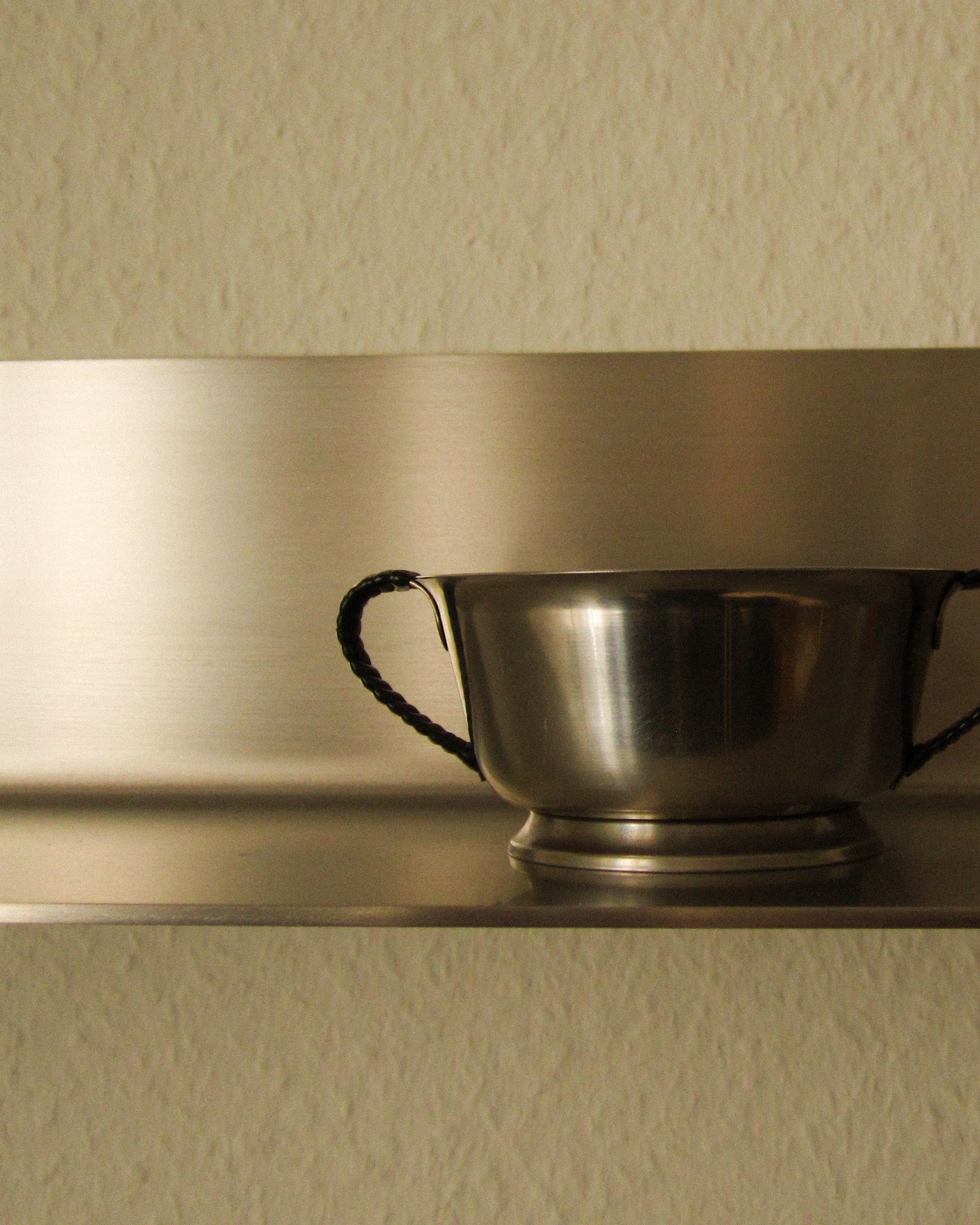
The finish is intentional: a moderate, linear brushing that conceals small touch marks better than completely polished surfaces. When cleaning the Skagen, follow the grain on the backplate with a microfiber cloth, rinse, and dry. For small scratches, a fine non-woven pad can be used, always in the direction of the shelf's grain. Introduced materials should be discussed precisely; here, it is especially the contrast between the brushed backplate and a potential mirror-polished object that creates visual depth in a bright, Nordic interior.
Functionally, the shelf pairs well with warm materials such as oak, leather, and marble in Danish, understated decor, where the steel surface reflects daylight and enhances the sense of space in smaller rooms. See more about proportions and applications for the Skagen steel shelf on Acier Studios' page.
Craftsmanship in Aarhus: Why the Finish Lasts Longer
Handmade production in Denmark provides control over the sequence of processing: welds are ground in the same direction as the final grain, tools and abrasives are strictly kept separate from carbon steel, and clean, dedicated non-woven and belts are used that do not deposit foreign metal. The quality of grinding at joints and edges means that dirt does not "cling" to micro-burrs, and the surface passivates uniformly after the final wash. This discipline in workshop routines reduces the risk of early tea staining and minimizes maintenance in the long term.
For interior furniture, the technical trade-off is typically between the fineness of the grain and the desire to hide touch marks. A moderate, uniform brushing provides a calm mirror of the room's light and suits Danish, material-conscious environments where stainless steel stands side-by-side with wood and stone. In homes near the coast, extra robustness can be achieved by more frequent wiping and, depending on the use case, by choosing an alloy and finish that handle chlorides better.
In conclusion, longevity is a matter of coherence: the correct alloy for the environment, a stringent workshop finish, and small, consistent care steps at home. When these three elements are in place, stainless steel not only lasts a long time; it patinas with dignity, retains its tactility, and adds the same clear material voice to the room year after year.

