

Stainless steel shelf: material logic, finish and application
Function first: why choose a stainless steel shelf
A stainless steel shelf solves three key tasks in interior design: load-bearing capacity in a slim profile, precision in geometry and a neutral, hygienic surface. Sheet steel can be folded into rigid profiles with minimal material thickness, so the shelf appears light in the room without yielding to bookshelves or stoneware. The flat surface and sharp edges provide a precise, architectural expression that supports Scandinavian minimalism and modern luxury.
The indoor climate benefits from the material. In dry living areas, the corrosion load is low, and stainless steel maintains its surface without post-treatment. In interior design, this offers freedom: use shallower depths to keep proportions light in hallways and kitchen-diners, incorporate visible bends or edge details as deliberate, technical markers, and balance the steel's coolness with oak, wool or polished marble. Consider the direction of light in relation to the shelf's grain direction; this determines how visible micro-scratches and fingerprints appear.
The passive film: chromium content, oxygen and self-repair
Stainless steel types typically contain at least approximately 10.5 percent chromium. The chromium reacts with oxygen to form an ultra-thin, dense chromium oxide film, the so-called passive film, which blocks further oxidation. If the surface is scratched through this film, it will re-form in the presence of oxygen; therefore, stainless steel "self-heals" under normal indoor conditions. As Euro Inox / WorldStainless documents, resistance increases with higher chromium content and any alloying elements such as molybdenum, while chlorides, contamination with iron particles or incorrect heat treatment can undermine passivity.
Indoors, chloride levels and condensation are typically low, and the passive film remains stable. Challenges arise if the surface is soiled with chloride-containing cleaning agents, if iron particles from tools are embedded, or if moisture is trapped in narrow crevices. Therefore, correct post-treatment and conscious use are crucial for the shelf to maintain its corrosion resistance.
Surfaces for interiors: finish, scratch sensitivity and cleaning
The choice of finish affects aesthetics, cleaning and how wear becomes visible. Indoor shelves are typically made from cold-rolled sheet with a controlled finish. Generally, smoother, reflective surfaces reflect light precisely but show micro-scratches and fingerprints clearly, while satin and brushed surfaces camouflage signs of wear and are tactile to the touch.
- 2B/BA: even, cold-rolled or bright annealed, relatively smooth; good cleanliness, moderate scratch visibility
- No.4 brushed: linear satin with clear grain direction; robust in use, hides micro-scratches when cleaning follows the grain
- No.8 mirror: high gloss, strong reflection; shows micro-wear significantly, requires careful care
- Electropolished: very smooth, corrosion-friendly in demanding environments; technical, almost pore-free surface
- PVD colours: ceramic-like coating on steel; high wear resistance, but scratches through the coating will appear metallic
During manufacturing, the sheets must be kept free of iron contamination, and heat tinting in heated zones should be removed by pickling or passivation to restore a fully active passive film. On shelves with a No.4 finish, the grain direction should be oriented horizontally, so that scratches from use and wiping are in the same direction.
Skagen wall shelf: construction and details
Skagen is Acier Studio's wall-mounted stainless steel shelf, developed for rooms where precise geometry and material honesty are desired. The profile is bent in a clean, controlled fold that acts as a stiffening edge; the flat surface appears even, and the edges are sharp, but hand-finished for tactile comfort. The surface is brushed to a controlled satin, so the light streak from the sanding is uniform and calm across the lengths.
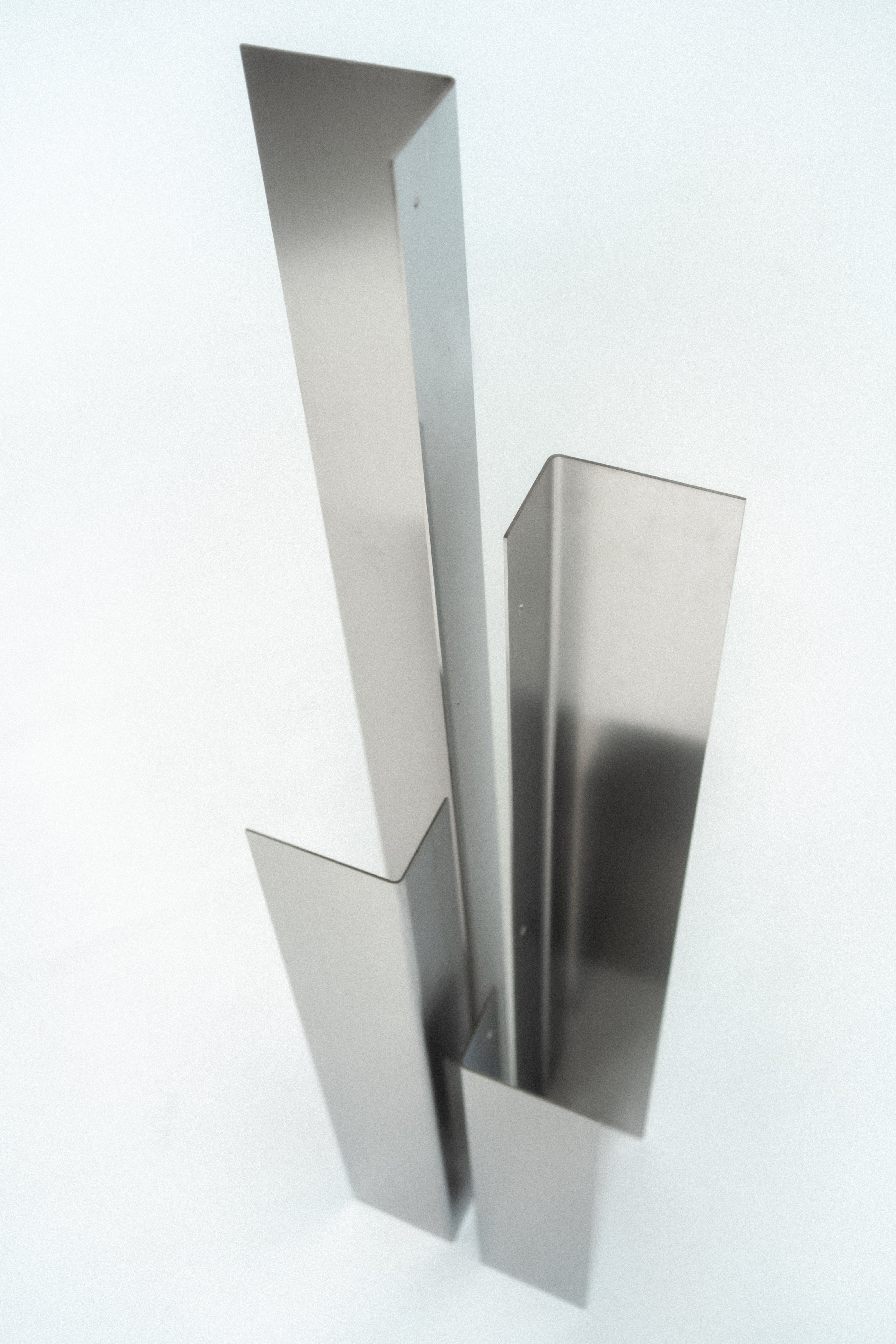
The image above shows three lengths arranged vertically in a studio setup without props. The overview clearly shows the profile's fold and grain direction; the shelf is read as a precise object, not a stage set. In practice, the narrow visual thickness makes Skagen suitable above kitchen counters or in hallways, where a prominent shelf can easily seem dominant. See more specifications for Skagen on the product page.
Danish manufacturing in Aarhus: craftsmanship as corrosion protection
The craftsmanship behind a stainless steel shelf is not ornamental; it protects the material's properties. In Aarhus, bending, assembly and finishing take place on a small scale with fixed fixtures and manual grinding. Tools and abrasives are kept separate from black steel, so ferromagnetic particles do not contaminate the surface. Heat-affected zones are subsequently treated to remove heat tinting and fully restore passivity. Edges are minimally chamfered and polished in the same direction as the flat surface, so the transition appears integrated and easier to keep clean.
This approach not only provides perfectly straight tolerances; it also ensures that the shelf retains its corrosion resistance in daily use. Read more about materials and methods in our review of production and materials.
Maintenance and realistic limitations indoors
Indoors, stainless steel requires moderate care if you work with the material and not against it.
- Wipe with microfibre and lukewarm water with a mild, pH-neutral dish soap. Wipe dry to avoid limescale rings.
- Follow the grain direction on brushed surfaces for both cleaning and spot removal. Transverse movements increase the visibility of scratches.
- Avoid chloride-containing cleaning agents, chlorine/bleaches and acidic descalers directly on the surface. If spilled, rinse immediately with clean water.
- Never use steel wool or tools that can deposit iron particles. Any "tea staining" from external iron particles should be removed with a non-metallic scouring pad and mild abrasive, followed by thorough rinsing and drying.
- Adhesive residues from labels can encapsulate moisture and salts; remove them with mineral spirits or isopropyl alcohol, not acetone on PVD coatings.
- In coastal homes or rooms with salty air, more frequent wiping is required to prevent chloride build-up in corners and behind mounts.
Small scratches on No.4 can be toned down with a fine, non-woven sanding pad in the shelf's grain direction. Stop as soon as the tone matches the rest; over-polishing will make the area shiny. Mirror-polished surfaces require a soft cloth and liquid polish without abrasive particles.
Long-term value arises when the material's properties are consistently utilised: corrosion resistance is maintained by a clean, oxygenated surface; finish is kept calm by working with the grain; installation and use avoid hidden moisture traps. A stainless steel shelf executed in this way therefore ages predictably and can be refreshed without replacement. For interiors where calm lines and materials are a design value, it is a durable choice that bears its patina soberly and for a long time.

