

Stainless Steel Shelf: Function, Material Choice, and Maintenance in the Home
Why Stainless Steel Outperforms Regular Steel in the Home
A stainless steel shelf primarily solves a practical problem: it supports weight, withstands moisture, and stays clean without requiring lacquer or paint. This differs significantly from regular steel, which quickly discolors and rusts in the kitchen, bathroom, and hallway. The difference lies in the material's surface chemistry. When stainless steel contains enough chromium, a thin, passivating oxide film forms, which self-repairs in oxygen-rich environments. A review published via ScienceDirect describes how this film regenerates after minor scratches, maintaining corrosion resistance over time.
- Corrosion Resistance: the chromium-rich passive film protects where ordinary steel rusts
- Cleaning: smooth, mechanically processed surfaces release dirt more easily than painted steel
- Lifespan: correct steel quality and finish provide long-term function without peeling
- Aesthetics: a calm, monolithic expression that does not patinate uncontrollably
The choice of quality begins with the alloy. AISI 304 is standard in dry, indoor areas. In coastal or wet environments, 316/316L with molybdenum provides increased resistance to chlorides and pitting corrosion. After processing, chemical passivation or electropolishing can re-establish the protective film, ensuring welds and edges perform on par with the flat surface.
Material and Finish: Expression, Touch, and Everyday Life
The mechanical finish of the surface controls both light and practicality. A finely brushed direction, often referred to as No. 4 or hairline, feels warm in tone, dampens reflections, and hides fingerprints in daily use. Mirror-polished sections add precision to small details like a rounded front edge but show touch more clearly. According to the design guide at Marcelina Furniture, the combination of stainless steel with warm materials such as oak, leather, and matte stone contributes to a Scandinavian whole, where the cool clarity of the steel is balanced by tactile contrasts.
In compact kitchens and hallways, a brushed shelf serves as a calm backdrop for everyday objects. The longitudinal brushing direction should follow the length of the shelf to enhance the overall impression and facilitate cleaning. Edge treatment makes a difference in use: a slightly broken edge feels comfortable to the touch and avoids damage from ceramics or glass, while a sharp, untreated edge collects dirt and appears visually harsh.
Danish Manufacturing at Acier Studio: What Makes the Difference
Small-batch production in Denmark is a quality argument because speed and method are controlled. In our workshop in Aarhus, low-heat TIG welding with carefully matched filler material is used, so heat zones are kept compact, and the grain structure of the plate is preserved. Joints are meticulously prepared, and subsequent mechanical finishing is done gradually to ensure a uniform brushing direction across surfaces and corners. On the bench, the surface is passivated again, so welds and flat areas achieve the same corrosion performance and visual tranquility. These steps distinguish atelier work from high-speed welding, where rough heat input and uneven dressing often compromise both durability and expression.
Product Insight: Skagen Stainless Steel Wall Shelf
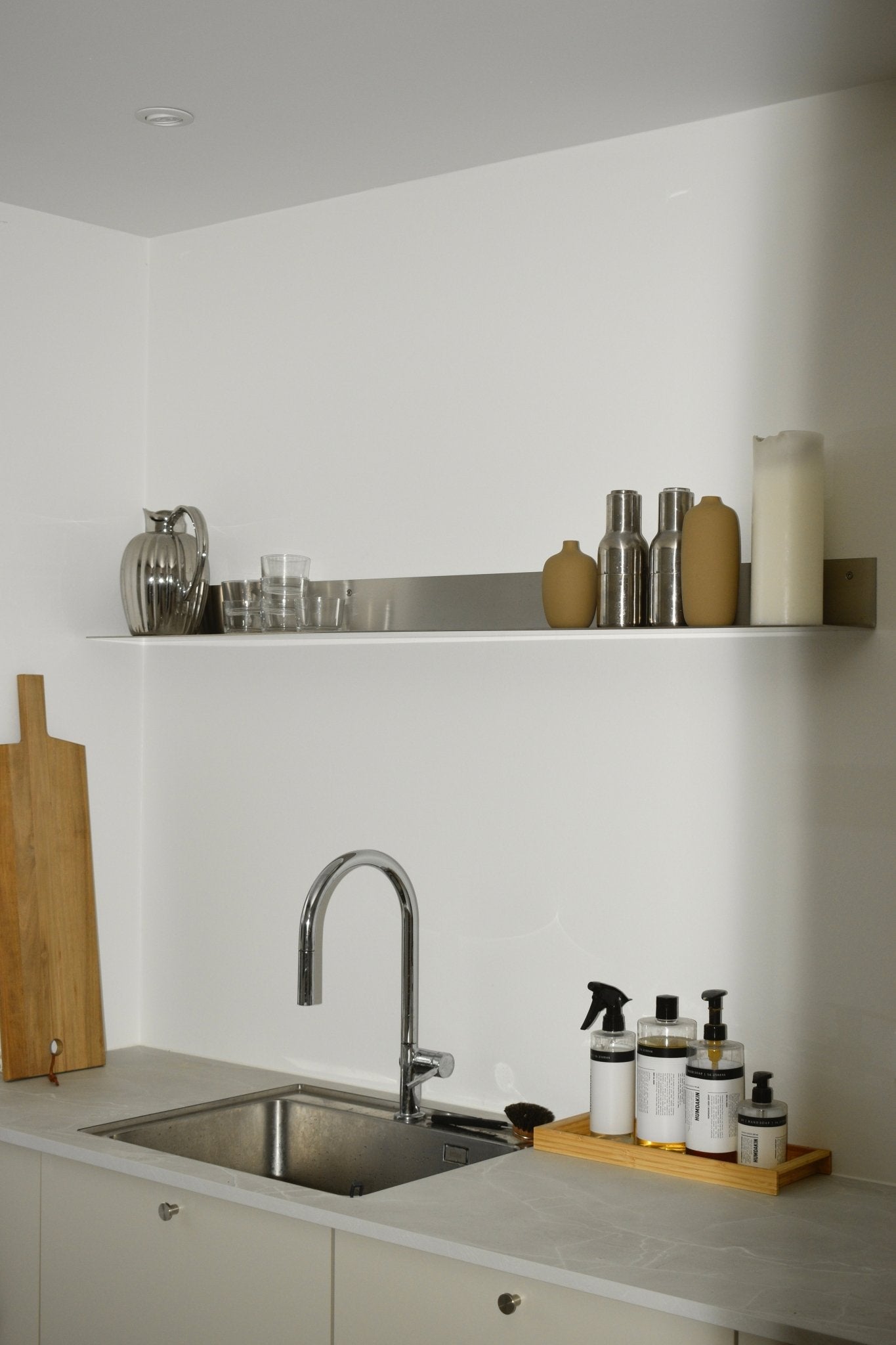
Skagen is a wall-mounted stainless steel shelf developed for kitchens and hallways, where moisture, splashes, and grease require a robust surface. The shelf's surface has an even, longitudinal brushing that looks calm against white walls and integrates naturally with chrome and brushed steel fixtures. The front edge is optically precise and slightly rounded, providing a smooth transition when glasses and ceramics are pushed into place. The surface tolerates daily wiping without losing its uniform sheen, and the straight edge shadow creates a clean visual line across the wall.
In use, the shelf demonstrates its strength above the sink. Splashes from water and vinegar do not leave discoloration when the surface is wiped regularly, and the brushed finish hides the fingerprints that inevitably appear in busy kitchens. The image below shows Skagen in a fully functional context with steel and ceramic objects, oil and vinegar, ochre-colored vases, and a thick pillar candle. The combination with a wooden cutting board and chrome faucet shows how brushed stainless steel binds the materials together without dominating.
For technical specifications and finish variants, please refer to the Skagen steel shelf on our website.
Maintenance: Honest Practice for Stainless Steel
Stainless steel requires less maintenance than painted or lacquered steel, but not none. The British Stainless Steel Association recommends mild, chlorine-free agents, rinsing with clean water, and wiping in the direction of the grain. Avoid steel wool, abrasive sponges, and chlorine-based cleaning agents, which can initiate pitting corrosion, especially near salt and steam. In the kitchen, it is wise to quickly remove vinegar, lemon juice, and salt residues. If the surface has been in contact with black steel or iron particles, tea-colored discolorations may occur; here, targeted passivation helps rebuild the protective film. In coastal areas or shower zones, 316/316L should be considered, as molybdenum in the alloy improves resistance to chloride-containing splashes.
A practical rhythm works: wipe daily in high-use areas, wash lightly weekly with a pH-neutral agent, and perform a more thorough cleaning and eventual passivation as needed, especially if incipient tea-staining is observed.
Long-term Value
A stainless steel shelf represents value over time, not just in acquisition. The material resists corrosion without coatings, maintains its appearance through mechanical finish, and can be renewed by light sanding or passivation if accidents occur. In terms of interior design, the shelf functions as a neutral, precise surface that supports changing objects and materials year after year. When the alloy, finish, and manufacturing method are chosen correctly, it becomes a lasting element in the home with low susceptibility to trends and high resistance in everyday life. It is the quiet type of investment that continues to deliver both function and visual tranquility.

